Multilingualism without additional effort: AI-supported translations in TYPO3 using the example of Chemnitz.de
Especially in the public sector, multilingualism is no longer an option, but a daily reality. Content must be made available in several languages - and not just at some point, but ideally at the same time.
In practice, things often look different: A page is updated, but the English version is left behind. Content is exported, translated externally and then re-entered later. Or editorial teams work in parallel in different tools to keep content synchronised. This takes time, leads to inconsistencies and quickly becomes confusing as the website grows.
Multilingualism in the Chemnitz project: increasing demands on editing and processes
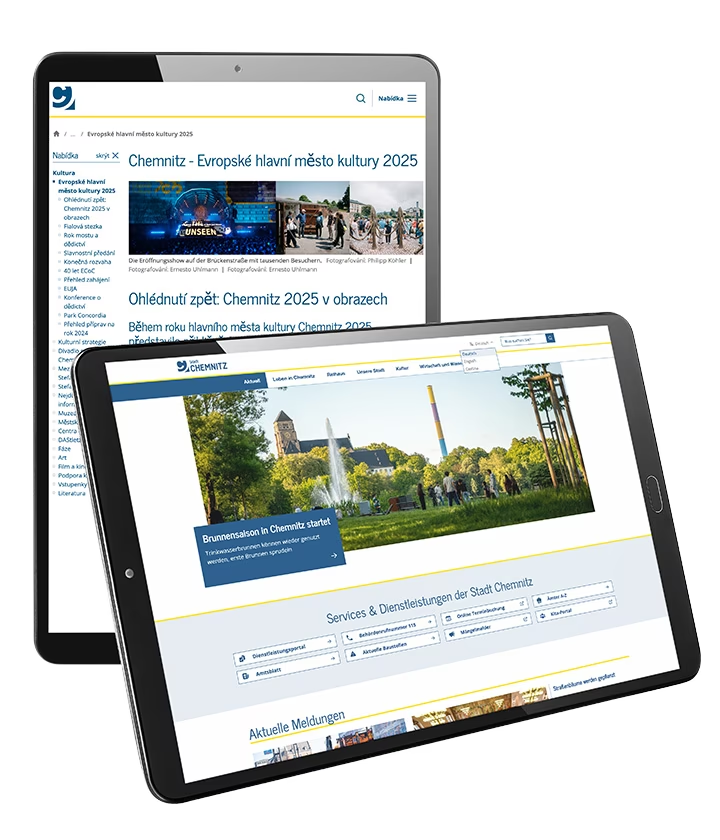
The city of Chemnitz faced precisely this challenge when migrating its website from Imperia to TYPO3. Previously, only selected content was provided in English - mainly due to limited personnel and time resources. However, with the role as European Capital of Culture 2025, the requirements changed significantly: content had to be more comprehensively and reliably available in multiple languages, particularly in English and Czech - with the prospect of expanding to other languages in the future.
At the same time, the existing structure presented typical challenges: large volumes of content, ongoing updates and the need to maintain several language versions consistently. Traditional translation processes would have meant that every change would have to be updated several times - with the corresponding maintenance effort.
The project therefore deliberately took a different approach: Multilingualism should not run alongside the actual editorial process, but should be integrated directly into it.
Automated AI translations as part of the editorial process
In order to implement AI translations as part of the editorial process, Netresearch implemented a DeepL integration directly in TYPO3 and expanded it in the course of the project. The existing extension was functionally optimised and adapted to the requirements of the project - the further developments were then made available to the open source community. Since then, content can be generated directly in the backend using AI-supported translation - exactly where it is created and maintained. The difference can be seen in everyday life: new content can be made available immediately in several languages without any additional maintenance effort. Changes to the original can be transferred directly so that language versions do not diverge.
For the editorial team with over 100 editors, this means above all a simplification of processes. Content is maintained centrally and displayed in multiple languages without having to switch between systems. At the same time, it remains possible to specifically check translations and adapt them editorially.
The effect is particularly clear with large volumes of content. While manual translation processes become exponentially more complex with each additional page, the effort involved in using AI-supported translation remains scalable and largely independent of the overall size of the website.
For Chemnitz, this means that content is available to international users without delay. Information for visitors, investors or specialists can be accessed directly - regardless of how frequently content is updated. The approach also pays off internally. Translations no longer have to be organised or updated separately, but are an integral part of the editorial process. This noticeably reduces the maintenance effort and ensures that content remains consistent across all language versions.
The project thus clearly shows that automated, AI-supported translations in TYPO3 are not an additional feature, but solve a central problem in the ongoing operation of websites. Multilingualism is no longer a bottleneck, but an integrated, functioning process.