Migration at the highest level: How Chemnitz.de was migrated to TYPO3
Anyone rebuilding an entire city website is entering sensitive digital terrain: old systems, new requirements, lots of data, little tolerance for errors - and all under time pressure. This was also the case with our project with the city of Chemnitz.
As the European Capital of Culture 2025, the city was not only facing a year full of visitors and international attention, but also the relaunch of its official website. A project with weight - and with some challenges that we not only mastered, but turned into real progress for our client.
Starting point: An ageing system with many legacy issues
Since 2005, chemnitz.de had been based on the CMS Imperia - proprietary, complex and technically outdated. Most of the content had to be maintained manually, external data could only be displayed centrally with a great deal of effort, and accessibility or multilingualism could hardly be implemented.
At the same time, the amount of content had grown massively over the years: around 16,000 documents, more than 80 GB of media files and over 31,000 content elements. It was clear that there would be no simple "relaunch and you're done".
One of the biggest challenges: Netresearch had no direct access to the old system. Imperia ran exclusively in the protected city network of Chemnitz. The data was therefore not delivered via export or API, but via structured Python arrays from the previous service provider. This sounds cumbersome - but was ultimately the basis for an automated and repeatable migration.
We developed our own TYPO3 extension to correctly transfer the complex data volumes into TYPO3. It analysed the supplied structures, assigned them to the new TYPO3 pages and content types, secured internal links and correctly integrated media.
Importantly, the import had to remain repeatable at all times so that new content from ongoing operations could be continuously transferred. This meant that editorial work could continue as usual without interruption until the time of the system changeover.
A second system: Drupal content was also migrated
In addition to the Imperia system, another CMS was used for content maintenance on chemnitz.de - Drupal, which was used separately for the event calendar. This content was also to be integrated into the new TYPO3 system so that the company's own events could be managed in TYPO3 only in future and a third-party system could be dispensed with.
The challenge: The prevailing data structure of the events in Drupal had to be mapped with the available data fields in TYPO3 in order to transfer the content completely.
A separate migration module was used to transfer all important event data - such as event titles and descriptions, organisers, media and categories - from Drupal to TYPO3. The imported events could then be immediately displayed in the new event calendar and filtered by users.
With the successful import of the Drupal content, the system previously used in parallel could be switched off - a further step towards a consistent, maintainable overall platform.
Parallel to migration: styling, structure and quality assurance
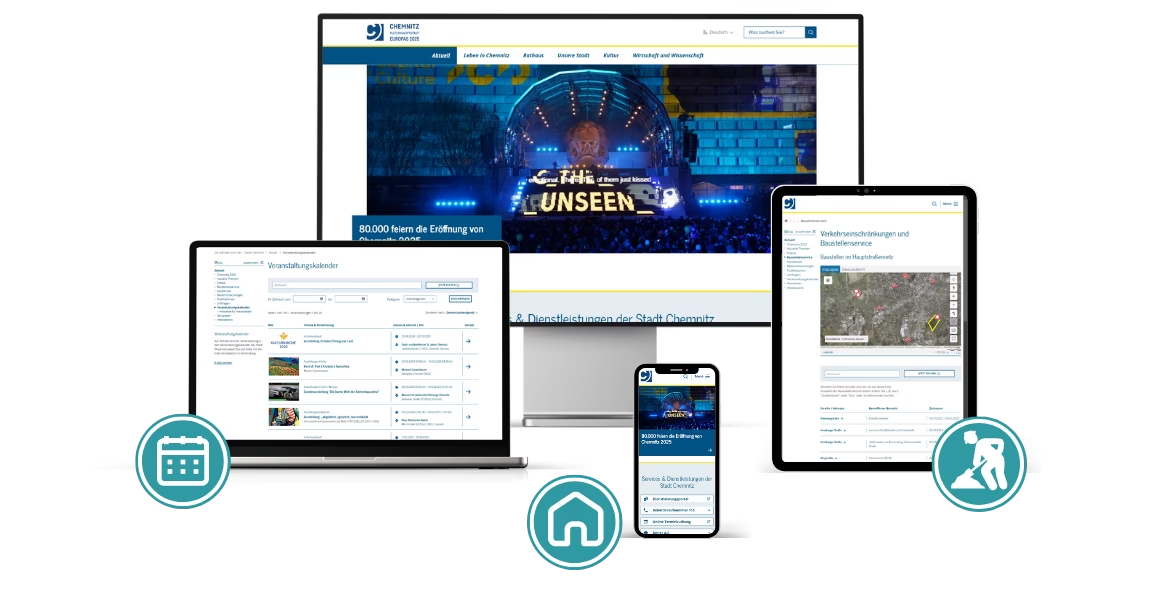
While the content was being transferred to TYPO3, the new, barrier-free design - including optimised navigation, a modernised page structure and clear templates - had to be implemented in the front end at the same time.
To ensure that migration and design did not hinder each other, the content elements were provided in their raw form in the new system at an early stage. This meant that migration and front-end optimisation could be driven forward simultaneously.
A particularly helpful feature: automated tests allow screenshots of the old and new systems to be compared for hundreds of pages. This makes it possible to recognise immediately if something is missing, has slipped or has not been transferred correctly in terms of structure.
Media, links, relations - everything has to be right
With a migration of this magnitude, it is not enough to simply transfer content - it must be transferred true to context. Every page, every image, every internal link had to function in the new system in exactly the same way as before.
With 80 GB of media material in particular, this is no small feat. An import mechanism was therefore developed that checks all references, cleanly rewrites paths and logically reorganises the file structure.
The result: no broken links, no media clutter - but consistently clear and coherent assignments.
From copy & paste to fully automated integration
However, one of the biggest advances resulting from the migration was not just the new interface or the improved performance - but the new data intelligence in the backend. What used to be maintained manually is now fully automated:
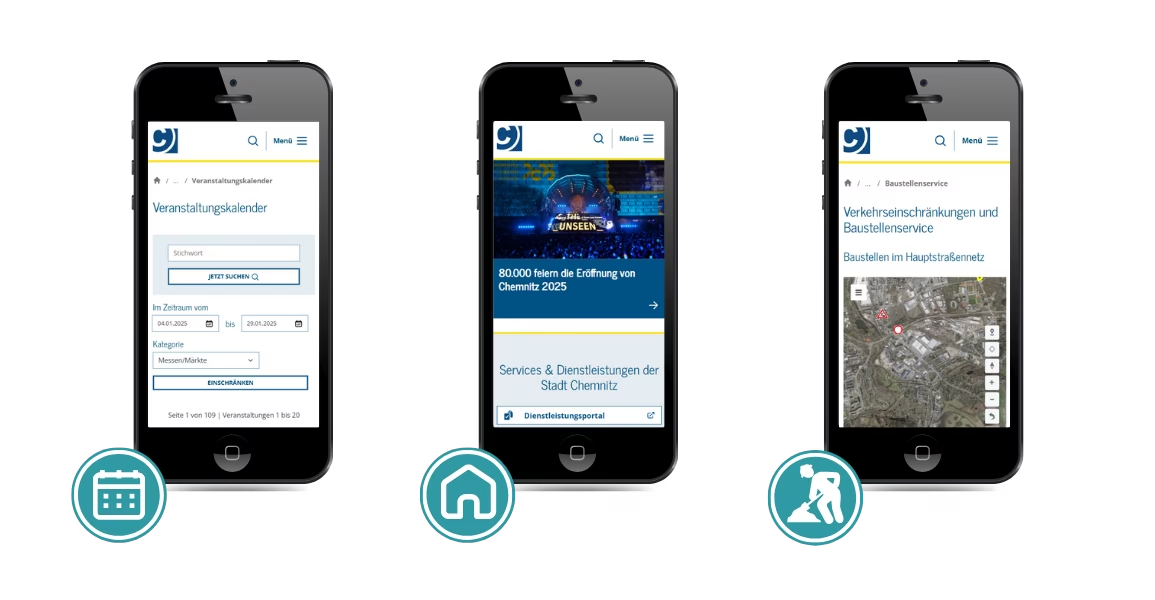
- The event calendar obtains up to 2,000 events a day from systems such as C3, Chemnitz Theatre and chemnitz2025.de.
- Construction site reports are taken from the city's ArcGIS system.
- The services from the citizen portal appear automatically on the website.
This automation not only drastically reduces the editorial workload - it also ensures that content is always up-to-date and automatically disappears from the website when it expires.
Better editing - through system and support
What was particularly lacking in the old system was usable documentation. There were no instructions, no community and no possibility of solving minor problems in everyday editorial work yourself. This is different with TYPO3! In addition to the extensive public resources available for users and administrators, a customised manual was developed for Chemnitz, which can be accessed directly in the backend at any time. It includes
- an overview of all content elements
numerous instructions on important settings
a clear description of the assignment of rights and roles
Assistance with the editorial workflow
as well as common everyday use cases
This makes the editorial team much more independent of the agency or internal IT and allows them to solve many tasks independently - efficiently and comprehensibly.
And because Chemnitz thinks internationally - now also multilingual
For a city with European appeal, language is a key issue. The old website had hardly any provision for translations. The new system takes care of this automatically: all content is translated directly into English and Czech via DeepL integration - further languages are planned.
At the same time, the entire website was made accessible in accordance with the WCAG guidelines and a comprehensive rights and roles concept was implemented for around 100 website editors - including notifications and comment functions in the approval process.

"The change of agency and CMS was a challenging task for the City of Chemnitz's website - but one that was handled excellently. The chemistry with Netresearch was right from day one: we appreciate the reliable cooperation at eye level. Throughout the entire project - from the concept to the migration of the existing website to the actual launch in the new system - we felt that we were competently looked after."
Thomas Liebert
Team Leader Internet
City of Chemnitz
Conclusion: Migration as a strategic lever
The migration of Chemnitz.de was no ordinary relaunch - it was a digital reboot, a huge leap forward! With a clear concept and the right technical architecture, the entire portal was restructured, automated and future-proofed.
Today, the website of the City of Chemnitz has a system that is not only scalable, barrier-free and high-performance - but also ready for new content, growing requirements and the major appearance as European Capital of Culture.
Are you planning a CMS change or facing a complex migration?
Let's talk about how we can transfer your content to TYPO3 in an efficient, secure and structured way.
Is your old system becoming a burden?
We can help you to migrate even complex structures securely and without loss - with best practices for authorities, cities and public organisations.